








Your Banking Data May Have Been Exposed: What Happened After the FICOBA Account Access and How It Could Affect You
You have received an alert from your bank. A message informing you of unauthorized access to a record containing data linked to bank accounts.
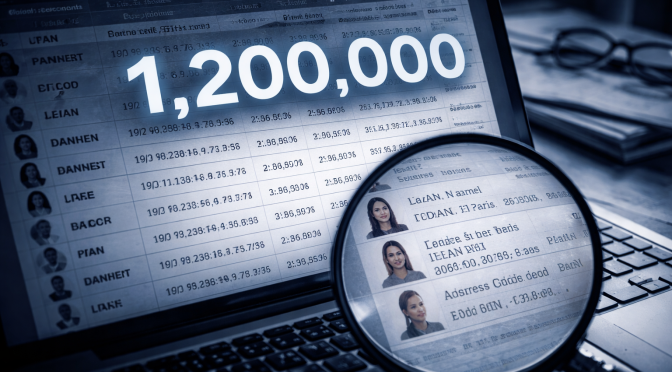
On February 18, 2026, the Ministry of the Economy confirmed that an unauthorized actor managed to consult information from approximately 1.2 million records in the FICOBA system. Not all people with bank accounts are involved, as the access was limited to a specific set of records. However, for those who are part of that group, understanding what really happened and how it could affect them is essential.
The news quickly appeared in economic headlines. For many, it was just another technical incident. But when analyzed more closely, questions arise that directly affect millions of people:
- Are my data included?
- Can my IBAN be used to commit fraud?
- Is there a real risk to my finances?
- What should I do now?
This article explains, clearly and precisely, what happened, what information was consulted, what risks exist, and what concrete actions should be taken.
What exactly is FICOBA and why it is relevant
The Fichier national des comptes bancaires et assimilés, known as FICOBA, is a registry managed by the French Directorate General of Public Finances. Its function is to identify all bank accounts opened in the country: current accounts, savings accounts, and other financial accounts.
It is important to understand what FICOBA is not.
- It does not store bank balances.
- It does not allow account operations.
- It does not record financial transactions.
- Its purpose is administrative and fiscal.
It allows judicial, tax, or administrative authorities to identify in which bank a given person holds accounts.
According to official information from the French Ministry of the Economy, the file contains data such as the account holder’s identity, address, associated bank, and account number or IBAN [1].
In other words, FICOBA does not contain your money, but it does contain the gateway that allows someone to identify where you keep it.
What happened and when the unauthorized access was detected
The Ministry of the Economy confirmed on February 18, 2026, that a “acteur malveillant” managed to consult FICOBA data without authorization [1].
The intrusion did not occur through a massive server attack nor through a technological vulnerability exploited from outside. According to information reported by Boursorama, the access occurred through the misuse of legitimate credentials belonging to an authorized official [1]. In other words, it was not a traditional cybersecurity breach in the classic technical sense. It was a case of digital identity compromise.
The unauthorized access is believed to have begun in late January 2026 and was later detected through internal controls, leading to the official notification on February 18 [1].
Scale of the consulted records
Authorities reported that approximately 1.2 million bank accounts were consulted illegitimately [2].
It is important to stress that this does not mean 1.2 million transfers, nor 1.2 million thefts of money. It means 1.2 million records consulted within an administrative file.
However, each of those records represents a real person with associated personal data.
What data were exposed exactly
According to information published by Boursorama and confirmed by regional French media, the potentially exposed data include [1][2]:
- First and last name of the account holder
- Date and place of birth
- Address
- Bank where the account is held
- Account number or IBAN
- In some cases, tax identification number
The following were not exposed:
- Banking passwords
- Access codes
- Account balances
- Transaction history
- Bank card data
This distinction is crucial. The access was significant, but it did not allow direct operation of the accounts.
How this information can be useful to a criminal
Many people believe that sharing an IBAN carries no risk. It is true that an IBAN alone does not allow an account to be emptied. However, combined with other personal data, it can become a powerful tool for fraud.
Let’s look at some concrete scenarios.
1. Fraudulent direct debit fraud
In Europe, SEPA direct debit mechanisms exist. In some cases, an IBAN and certain personal data are sufficient to attempt to set up a direct debit order.
A malicious actor could attempt to register a direct debit in the account holder’s name with less rigorous service providers. Although reversal mechanisms exist, the process can generate stress, lost time, and additional exposure.
A possible example: at some point, you review your bank statement and detect a monthly charge of €19.90 associated with an online subscription you do not recognize. You never subscribed to that service, but the direct debit appears valid because it was registered using your IBAN, your full name, and other correct personal data. The order was processed automatically within the SEPA system without your conscious authorization. The amount may not be high, but the fact that someone used your basic banking data to activate a recurring payment shows how seemingly limited information can become the starting point for ongoing fraud that is difficult to detect at first.
2. Targeted social engineering
If a scammer knows:
- Your full name
- Your address
- Your bank
- Your IBAN
They can build an extremely credible communication.
Realistic example:
An email or phone call that appears to come from your bank, citing your full name and the last digits of your account, requesting urgent verification due to “suspicious activity”.
The likelihood that the victim trusts the message increases significantly when it contains real data. The French Banking Federation explicitly warned about the risk of phishing attempts following the incident [3].
3. Impersonation with third parties
With sufficient personal data, a criminal could attempt to open financial services, take out phone lines, or initiate administrative procedures while impersonating the victim.
Although these attempts usually require additional information, the exposed data can facilitate the first step.
What measures did the authorities take
After detecting the unauthorized access, the authorities:
- Immediately restricted the compromised access
- Filed a formal complaint
- Notified the National Commission on Informatics and Liberties (CNIL), the data protection authority
- Initiated the notification process for potentially affected individuals
According to information published by L’Est Républicain, communication was initiated with the affected account holders to alert them about possible fraud attempts [2].
We are a technological innovation company specializing in cybersecurity, computer networks, and advanced digital solutions. Through audits, consulting, and design, we develop and manage critical infrastructures, combining technical expertise, international certifications, and cutting-edge research and development methodologies.
Our multidisciplinary team integrates engineering, risk analysis, auditing, and systems development to deliver comprehensive solutions tailored to complex environments. Each project is approached with technical rigor, precision, and a focus on resilience, efficiency, and operational security.
Is there international impact?
The FICOBA file is a French national registry. However, it is not limited to French citizens. It includes accounts opened in banks located in France, regardless of the account holder’s nationality.
This means that citizens of other European Union countries, foreign residents, or international companies with accounts in France may be included in the file.
At present, there is no public evidence that banking systems in other European countries were compromised in this incident. The access was limited to the French file. However, the potential scope is international due to the diverse composition of account holders.
Why staying calm is key
It is essential to avoid alarmism.
- No mass fraudulent transfers directly linked to this incident have been reported.
- Banking passwords were not compromised.
- There was no access to balances.
The main risk relates to the possible misuse of personal data for subsequent fraud attempts. Therefore, rather than panicking, it is reasonable to maintain active monitoring of bank account movements. The difference between panic and prevention lies in accurately understanding the real nature of the incident.
What you should do if you have a bank account in France
Official recommendations include [3]:
- Periodically review your account transactions
- Verify active direct debits
- Do not provide banking data by phone or email
- Be suspicious of urgent messages requesting immediate verification
Additional practical measures can be added:
- Enable transaction alerts in your digital banking
- Configure two-factor authentication
- Keep copies of banking contracts
- Ask your bank to confirm whether you may be affected
Why this incident matters more than it seems
This case is not just a story about an administrative file. It is a reminder of something deeper: modern financial infrastructure depends as much on technological security as on identity security.
In this case, a firewall did not fail. A credential did. The attack vector was human, and that changes everything.
Compromised credentials have become one of the main methods of illicit access in security incidents worldwide. There is no need to break the system if you can enter with the correct key.
This is where I have insisted in various previous publications [4] that the most vulnerable layer of any organization continues to be the human factor.
My experience leads me to observe a recurring pattern: many companies allocate significant budgets to strengthening their technological infrastructure, but invest considerably less in their internal collaborators. Firewalls, detection systems, or advanced encryption are not enough if the end user lacks basic cybersecurity training and elementary protection tools.
From something as simple as a properly managed access-controlled identification badge, to the mandatory use of dual-authentication USB keys, identity protection must be treated as a central part of security architecture, not as an optional add-on.
The psychological factor behind subsequent fraud
When a criminal possesses real data, they activate a powerful cognitive bias: trust through familiarity. The human brain tends to trust when it recognizes correct personal information. If a message contains your full name, your bank, and your partial account number, your level of alert decreases.
That is the real threat following the incident—not the access itself, but the strategic exploitation of trust.
What this case reveals about security in Europe
Although the incident is national, it occurs within a European context where data protection is regulated by the General Data Protection Regulation.
The fact that authorities formally notified and publicly communicated the incident shows the functioning of the regulatory framework, but it also demonstrates that no system is immune.
The question is no longer whether unauthorized access can occur, but how quickly it is detected and how transparently it is communicated. In this case, detection and notification occurred within weeks, indicating active control mechanisms.
Conclusion
Although there was no banking collapse or massive diversion of funds, the unauthorized access to approximately 1.2 million financial records confirms an uncomfortable reality: risk does not always manifest as visible losses, but as the silent exposure of sensitive information. The difference between vulnerability and protection lies not only in the strength of systems, but in the ability to understand what happened, what data were actually consulted, what was not compromised, and what actions should be taken with sound judgment.
Modern financial security no longer depends exclusively on advanced technological infrastructures, but on a protection ecosystem in which institutions and users play complementary roles. When clients stay informed, act calmly, and periodically review their banking movements, they not only strengthen their own protection, but also reinforce that ecosystem and indirectly reduce the room for maneuver of those seeking to exploit gaps and oversights.
This is not about adopting a confrontational role, but about exercising conscious and prudent vigilance. In this environment, information is not just knowledge: it is a silent, yet effective, form of collective defense.
* Personal information will be encrypted
Recent Comments
References
[1] Boursorama. “Un acteur malveillant a pu consulter les données du fichier des comptes bancaires.” February 18, 2026.
[2] L’Est Républicain. “Les données d’1,2 million de comptes bancaires consultées de manière illégitime à Bercy.” February 18, 2026.
[3] Fédération Bancaire Française. “Divulgation des données FICOBA: la FBF appelle à la vigilance.” February 2026.
[4] MR KNIGHT’S. Related publications on human factors, systemic vulnerabilities, and risk management:
– “Artificial Intelligence as a Cybersecurity Model: The Carbanak Case.”
– “The Cybersecurity Mistake That Could Destroy Your Company.”
– “Your Company Doesn’t Need Antivirus… Until the Day It Loses Everything.”
– “NIS2 and GDPR: Why Many Companies Think They Comply and It’s Not True.”
